
Cornish Rex
Curly coat, big ears, and endless play
Quick answer: The Cornish Rex is a small, athletic cat with a super-soft curly coat.
Personality Traits
Quick Facts
Overview
The Cornish Rex is the curly athlete of the cat world—slim, springy, and always ready to play. They’re very social and happiest when they’re part of everything you do. If you want a fun, affectionate, interactive cat, the Cornish Rex is a great match.
Personality & Temperament
Usually enjoys cuddles and being near people.
Likes interactive toys and learning games.
Needs daily activity and enrichment.
Learns routines fast; puzzle toys help a lot.
Personality in real life
Cornish Rex cats are playful and energetic. Many act kitten-like well into adulthood.
They’re very social and don’t love being left alone for long stretches.
They’re loyal and loving, and often want to stay in close contact with their people.
They can be a great family cat and usually do well with kids and other pets.
Many owners describe them as a little “dog-like” (following you around and loving games).
History
The Cornish Rex began in Cornwall, England, in 1950, when a kitten with a naturally curly coat was born on Bodmin Moor.
That kitten, later named Kallibunker, quickly drew attention because his coat was unlike anything seen before in cats.
Early breeders focused on preserving the unique coat and slim, elegant body, while using careful outcrossing to build a healthy and stable gene pool.
Over time, the Cornish Rex developed into a distinct breed and spread beyond the UK, becoming admired worldwide for its unusual look and playful personality.
Appearance
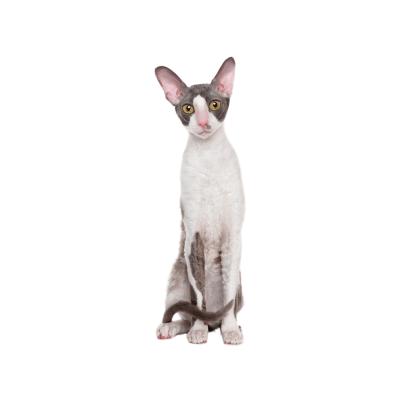
Small, athletic build with long legs and a naturally arched back.
Large ears and an alert, expressive face.
The coat is the breed’s signature. It is very short, incredibly soft, and forms tight waves that sit close to the skin.
Whiskers can be shorter and may look a bit curled.
Is a Cornish Rex right for you?
Good fit if:
- • You want a social cat that likes to “hang out” with you all day.
- • You enjoy daily play and an active, athletic personality.
- • You want a cat with a unique look and a low-maintenance coat.
- • You have kids, other cats, or a cat-friendly dog (and want a friendly breed).
Not ideal if:
- • You want a very independent cat that’s fine being alone most of the day.
- • You prefer a calm, low-energy lap cat with minimal play needs.
- • You want a “guaranteed” hypoallergenic cat (no breed can promise that).
Daily life with a Cornish Rex
Energy level
High. Expect lots of running, jumping, and play.
Noise level
Usually not super loud, but they’ll communicate when they want attention.
Attention needs
High. They like company and can get unhappy if they’re alone too much.
Grooming
Easy coat, but plan on ear cleaning and occasional baths if they get a bit oily.
Things to Know Before Adopting
- • They can get bored without enough play and interaction.
- • They often prefer company and may not do well with long, lonely days.
- • The short coat means they can feel cold easier, so they seek warm spots.
- • Ears may build up wax/oil faster than some breeds and need regular gentle cleaning.
- • Their coat can be a bit delicate, so skip rough brushing and be gentle.
Interesting Facts
TICA lists fun nicknames for the breed, including “the feline version of a whippet.”
CatsLib Team
Editorial & Research Team
CatsLib content is written and reviewed by our editorial team. We focus on clear, practical guidance for cat owners and regularly update articles when recommendations change.
About our editorial process
Sources & References
(3)
All information on CatsLib is backed by reputable sources. We regularly review and update our content to ensure accuracy.
Our editorial process: Every article is reviewed by veterinarians and feline behavior experts. We cross-reference multiple sources and update content regularly to maintain accuracy.
Frequently Asked Questions
Quick answers to the most common questions about this topic
1
Are Cornish Rex cats hypoallergenic?
No cat is truly hypoallergenic. TICA notes the Cornish Rex is often considered a better choice for some people with allergies, but reactions can still happen—try spending time with one first.
2
How much is a Cornish Rex cat?
Prices vary a lot by breeder, location, and pedigree. The safest move is to contact reputable breeders (TICA/CFA resources help) and ask about current kitten pricing and waitlists.
3
How long do Cornish Rex cats live?
TICA lists a life expectancy of about 9–13+ years.
4
How big do Cornish Rex cats get?
They’re small-sized. TICA notes females are commonly around 5–7 lb and males around 8–10 lb.
5
What is a Cornish Rex cat?
A Cornish Rex is a small, athletic cat best known for an ultra-soft short coat that forms tight waves, plus a playful, social personality.
6
What does a Cornish Rex cat look like?
They have a slim body, long legs, big ears, and a very short curly coat that sits in waves close to the skin.
7
Where can I get a Cornish Rex cat?
Start with breeder directories and cat shows. CFA and TICA both recommend shows as a good way to meet reputable breeders and learn what to expect.
Still have questions? We're here to help!